You brush. They rinse. And somehow, sugar still hides in those deep molar grooves after a treat on Manchester Road.
That’s why many parents ask us: how long do pediatric sealants last, and are they truly worth it? The answer starts with understanding that those chewing surfaces are full of tiny pits and fissures too narrow for toothbrush bristles. Sealants create a smooth, invisible shield that blocks bacteria before a cavity ever forms.
At Little Pearls Pediatric Dentistry in Manchester, MO, we use sealants as part of a proactive preventative dentistry plan trusted by families across West County, Ballwin, and Valley Park. In this guide, we’ll cover safety, longevity, and why sealants can stop cavities before they start.
The Science Behind Dental Sealants
The chewing surfaces of permanent molars are naturally uneven, full of narrow pits and fissures that toothbrush bristles simply cannot reach. Even with great brushing habits, bacteria settle into those grooves and begin breaking down enamel. That’s why most childhood cavities form in back molars.
Dental sealants solve this structural problem. The liquid dental resin flows into those microscopic grooves and hardens into a smooth, protective barrier. The result? A surface that’s dramatically easier to keep clean. Research supported by the American Dental Association shows sealants can reduce cavity risk in molars by up to 80%, a major reason today’s children experience fewer cavities than previous generations.
Safety matters to parents. Modern sealant materials are FDA-reviewed and contain negligible to no BPA exposure, at levels considered clinically insignificant. When applied by a pediatric dentist, sealants are one of the safest and most cost-effective preventive treatments available.
In preventative dentistry, stopping decay before it starts is always better than treating it later and sealants do exactly that.
When Should Kids Get Sealants?
The best time to place sealants is shortly after permanent molars erupt, typically around age 6 for first molars and age 12 for second molars. These newly erupted teeth have deep grooves and are more susceptible to tooth decay, especially while children are still building consistent brushing habits.
Here’s why timing is critical: once a cavity forms in a molar, the opportunity for pure prevention is gone. Sealants are most effective when applied to healthy enamel, before bacteria have a chance to penetrate those pits and fissures.
For families in Manchester, Ballwin, and across West County, we often recommend scheduling sealants during back-to-school visits or summer checkups before the Parkway and Valley Park school calendars ramp up. Protecting permanent molars early can dramatically reduce cavity risk during the most cavity-prone years of childhood.
Prevent first. Treat less later. That’s the goal.
What to Expect During a Sealant Appointment
Parents often expect something complicated. The reality? Sealants are one of the simplest procedures we perform.
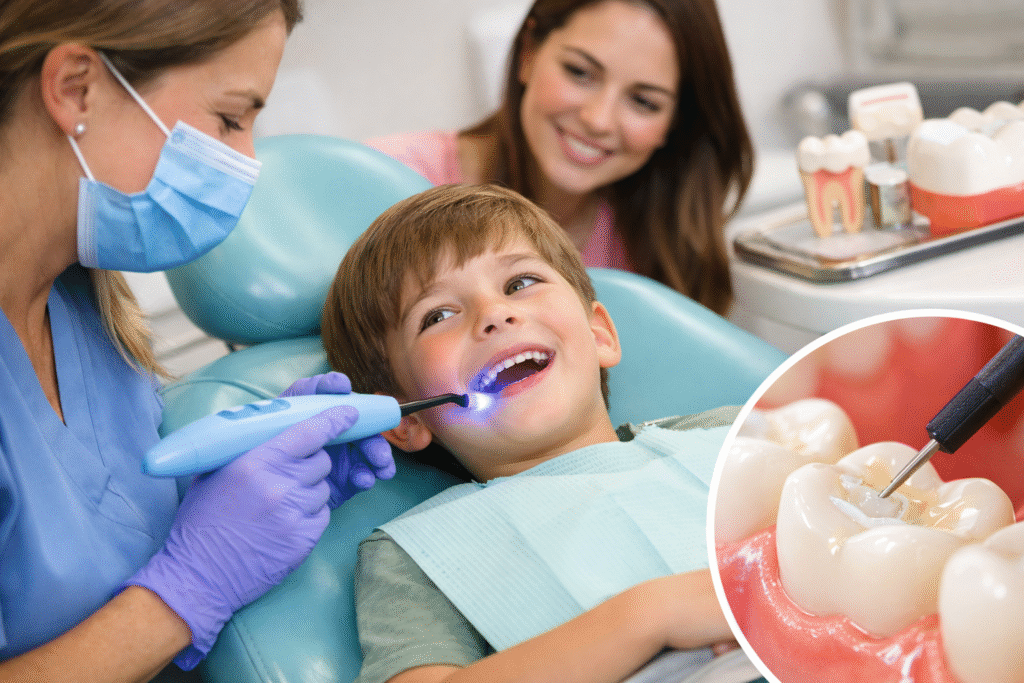
There are no drills, no shots, and no removal of tooth structure. The goal is protection, not repair. At Little Pearls Pediatric Dentistry in Manchester, MO, we make the experience calm and predictable, especially for younger or anxious patients.
Here’s exactly what happens:
- Step 1: Gentle cleaning to remove plaque (similar to an electric toothbrush feeling).
- Step 2: Light conditioning solution to prepare the enamel surface.
- Step 3: Painting on the dental resin into the grooves of the molar.
- Step 4: “Magic blue light” that hardens the sealant in seconds.
The entire appointment typically takes just minutes per tooth. Children are able to eat and drink normally the same day with a new invisible shield protecting their smile.
How Long Do Sealants Last?
Now to the question most parents are really asking: how long do pediatric sealants last?
With proper care, sealants typically last 5 to 10 years, often protecting a child’s molars through their highest cavity-risk years. The material is durable, but like anything in the mouth, it can experience gradual wear from chewing forces and diet.
To maximize longevity:
- Encourage consistent brushing to prevent edge breakdown
- Be mindful of very sticky candies or chewy treats that can tug at margins
- Avoid biting into extremely hard foods
- Keep routine 6-month visits so we can monitor the sealants
Here’s the important part: at every cleaning in our Manchester, MO office, we check sealants as part of preventive care. If a small area shows wear, it can usually be repaired quickly, no drilling required. With proper monitoring, many children maintain sealant protection well into their teen years.
Sealants vs. Fillings: The Financial & Health ROI
Here’s the real return on investment: a sealant is prevention. A filling is repair.
Sealants cost a fraction of what a composite filling does and dramatically less than advanced treatments that can follow untreated decay. Once a tooth requires a filling, that restoration will eventually need maintenance or replacement over time. Sealants help prevent that entire cycle from starting.
The good news for Manchester families? Most Missouri dental plans, including Delta Dental and Cigna, commonly cover sealants at 100% for children under 14. That makes them one of the highest-value services in pediatric preventive dentistry.
From both a health and financial standpoint, protecting permanent molars early is almost always the smarter long-term decision.
Schedule Before the Next Cavity Starts
Preventing cavities is always easier and more comfortable than treating them later.
At Little Pearls Pediatric Dentistry in Manchester, MO, we specialize in proactive cavity prevention for children across West County, including families in Ballwin, Ellisville, and Valley Park. Located at 1001 Brittany Pkwy Unit F-1, just minutes from Schroeder Park and major Parkway school campuses, our office makes preventive visits convenient for busy parents.
Sealants are quick, comfortable, and monitored at every 6-month checkup to ensure they continue protecting your child’s permanent molars during their most cavity-prone years. It’s part of our long-term commitment to preventative dentistry and trusted pediatric care.Protect your child’s smile before the next cavity starts. Call 314-343-1037 or schedule a consultation at our Manchester office today.